
Lexington County Probate Court Address and Judge
The Probate Court sits on the main floor of the Judicial Center, at the corner of East Main Street and South Lake Drive in downtown Lexington. The Probate Judge is Dan Eckstrom. The office is open weekdays from 8 a.m. to 5 p.m. It handles estate administration, marriage licenses, adult guardianships, conservatorships for adults and minors, and mental health commitments.
Lexington County Probate Court
205 East Main Street, Suite 134
Lexington, SC 29072
(803) 785-8324
Mon-Fri 8 a.m.-5 p.m.
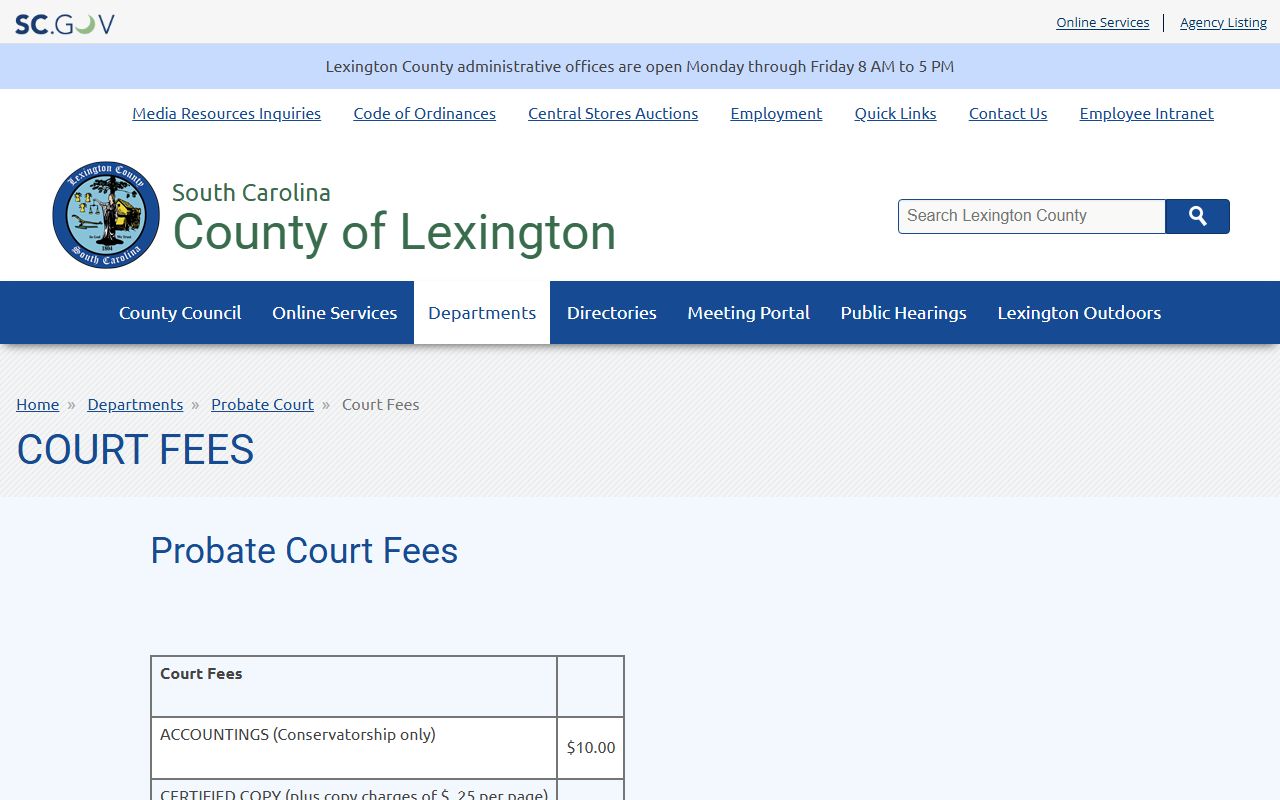
The court fees page lists every charge for estates, copies, and guardianships.
Estate and Marriage Search Date Ranges
The Probate Court page lists four official online searches, split by record type and date range. Estate searches cover 1865 to 1994 and 1995 to the present. Marriage searches cover 1911 to 1987 and marriage licenses from 1986 to the present.
- Estate Search, 1865 to 1994
- Estate Search, 1995 to present
- Marriage Search, 1911 to 1987
- Marriage License Search, 1986 to present
For copies or certified records, use Probate Court at 205 East Main Street, Suite 134, (803) 785-8324. Marriage record steps are on the marriage and divorce records page.
Opening a Lexington County Estate
Opening an estate starts with an appointment or a drop-off of completed forms. If you leave forms for review, appointment as personal representative usually takes about two weeks once the documents are complete. Call ahead to schedule with an estate clerk.
- Decide whether the estate qualifies for small estate handling or full administration.
- Gather the original will, the application, the death certificate, and the filing and publication checks.
- Call (803) 785-8324 to schedule an estate-clerk appointment, or leave completed forms for processing.
- Wait for the court to review and appoint the personal representative.
- Give notice to heirs and devisees within 30 days of appointment.
- File the inventory and appraisement within 90 days.
All fees must be paid by check or money order, and documents must be completed in ink with original signatures. Faxed documents are not accepted, and court staff cannot complete forms or give legal advice.
Required Estate Forms
South Carolina uses standard estate forms, and the court needs them filed in order. The main ones run from the first application through the final settlement. The list below covers the routine estate forms.
- Application/Petition (Form 300ES): asks the court to appoint a personal representative; must be signed and notarized.
- Information to Heirs and Devisees (Form 305ES): delivered within 30 days of appointment.
- Inventory and Appraisement (Form 350ES): due within 90 days, listing assets and values.
- Accounting (Form 361ES): filed after the creditor claim period.
- Application for Settlement (Form 412ES): filed within one year of first publication of the Notice to Creditors.
The probate code that governs this process is South Carolina Code Title 62, Chapter 3.
Inventory, Notice, and Accounting
After appointment, the personal representative has a set of duties on a timeline. Notice goes to heirs and devisees within 30 days. The inventory and appraisement, which lists the estate's assets and their values, is due within 90 days. Both steps keep the estate moving and keep heirs informed.
Later in the process come the creditor claim period, the accounting, and the settlement. The accounting shows what assets came in and what was paid out. If all heirs and devisees sign a waiver, the representative may not need to file a full accounting. The application for settlement closes the estate, filed within one year of the first creditor notice. A deed of distribution for real estate is filed at the Register of Deeds, then a clocked copy goes back to Probate Court.
Lexington County Probate Fees
Probate filing fees scale with the size of the estate. The fee is set on probate assets and recalculated after the inventory. Copies and certifications carry their own charges. The table below shows the main probate fees.
| Item | Fee |
|---|---|
| Estate $0 to $4,999 | $25.00 |
| Estate $5,000 to $19,999 | $45.00 |
| Estate $20,000 to $59,999 | $67.50 |
| Estate $60,000 to $99,999 | $95.00 |
| Certified copy | $5.00 plus $0.25 per page |
| Photocopies | $0.25 per copy |
| Guardianship / Conservatorship | $150.00 |
| Re-open estate | $22.50 |
Creditor advertisements run $30.00 each. Small estate fees start at $12.50 for estates below $100. The court sends a letter for an added fee or a refund if the estate value changes after the inventory.
Small Estate Fees and Procedures
Smaller estates pay lower, tiered fees. The amount tracks the value of the estate. The table below shows the small estate fee tiers from the Probate Court schedule.
| Estate Value | Fee |
|---|---|
| Below $100 | $12.50 |
| $100 to $4,999.99 | $25.00 |
| $5,000 to $19,999.99 | $45.00 |
| $20,000 to $25,000 | $67.50 |
An accounting for a conservatorship only is $10.00, and a demand for notice is $5.00. The court recalculates the filing fee after the inventory and sends a letter for any added fee or refund.
Common Probate Terms
Probate uses words that do not come up in daily life. Learning a few makes the forms easier to follow. The list below defines the terms you will see most often.
- Testator
- A person who makes a will.
- Executor
- The person named to carry out a will, also called a personal representative.
- Intestate
- Dying without a valid will, so state law decides who inherits.
- Guardianship
- Court authority to make personal decisions for an adult who cannot.
- Conservatorship
- Court authority to manage the money and property of someone who cannot.
The court cannot recommend a lawyer, but the Lawyer Referral Service is reachable at (803) 799-1700.
Wills, Intestate Estates, and Deeds
Probate handles two main estate paths. When there is a valid will, the named personal representative carries out its terms. When there is no will, the estate is intestate, and state law decides who inherits. The court reviews the circumstances and may need extra documents when no will exists.
Real estate adds a step. A Deed of Distribution, Form 400ES, is filed at the Register of Deeds in the county where the property sits, and a clocked copy is then filed with Probate Court. The Register of Deeds is a separate office from Probate Court, even though both touch property after a death. Estate documents must be completed in ink with original signatures, and the court does not accept faxed documents.
Guardianship, Conservatorship, and Commitments
Beyond estates, Probate Court handles cases about people who cannot manage their own affairs. Guardianships cover personal decisions for an adult. Conservatorships cover money and property for adults and minors. Each carries a $150 filing fee.
Probate Court also handles mental health commitments, which are sensitive. These records are restricted by mental health confidentiality law and court orders. The commitment statutes sit in South Carolina Code Title 44, Chapter 22.
Restricted Probate and Juvenile Records
Most estate files are open, since they become permanent public records when filed. But not everything in the probate world is public. Mental health commitment details are protected. Juvenile justice records are restricted under separate state law.
The juvenile record provisions are in South Carolina Code Title 63, Chapter 19, part of the Children's Code.
Note: Estate documents filed with Probate Court are permanent public records, so file legibly in black or dark blue ink.
Certified Probate Copies
For a certified copy of a probate record, contact Probate Court at 205 East Main Street, Suite 134. A certified copy is $5.00 plus $0.25 per page, and a plain photocopy is $0.25 per page. An exemplified or authenticated copy is $20.00.
For court case files outside probate, use the Lexington County court records page. For certified copies from the Clerk, see the Clerk of Court page.