
How to Search Lexington County Court Records
Most Lexington County court records are searched online through the South Carolina Judicial Branch Case Records Search and the Lexington County Public Index. The statewide page lets you pick a county and open its case records. Lexington County shows up there with Circuit Number 11 and County Number 32. The Public Index covers Circuit Court and Magistrate Court cases. Family Court cases use a separate state portal run through the Department of Social Services, and Probate Court keeps its own estate and marriage searches.
Before you start, gather what you know. A case number gives the cleanest result. If you only have a name, use the full last name and first name. The state page needs a browser with cookies and JavaScript turned on, and some browsers need a pop-up exception to open case detail.
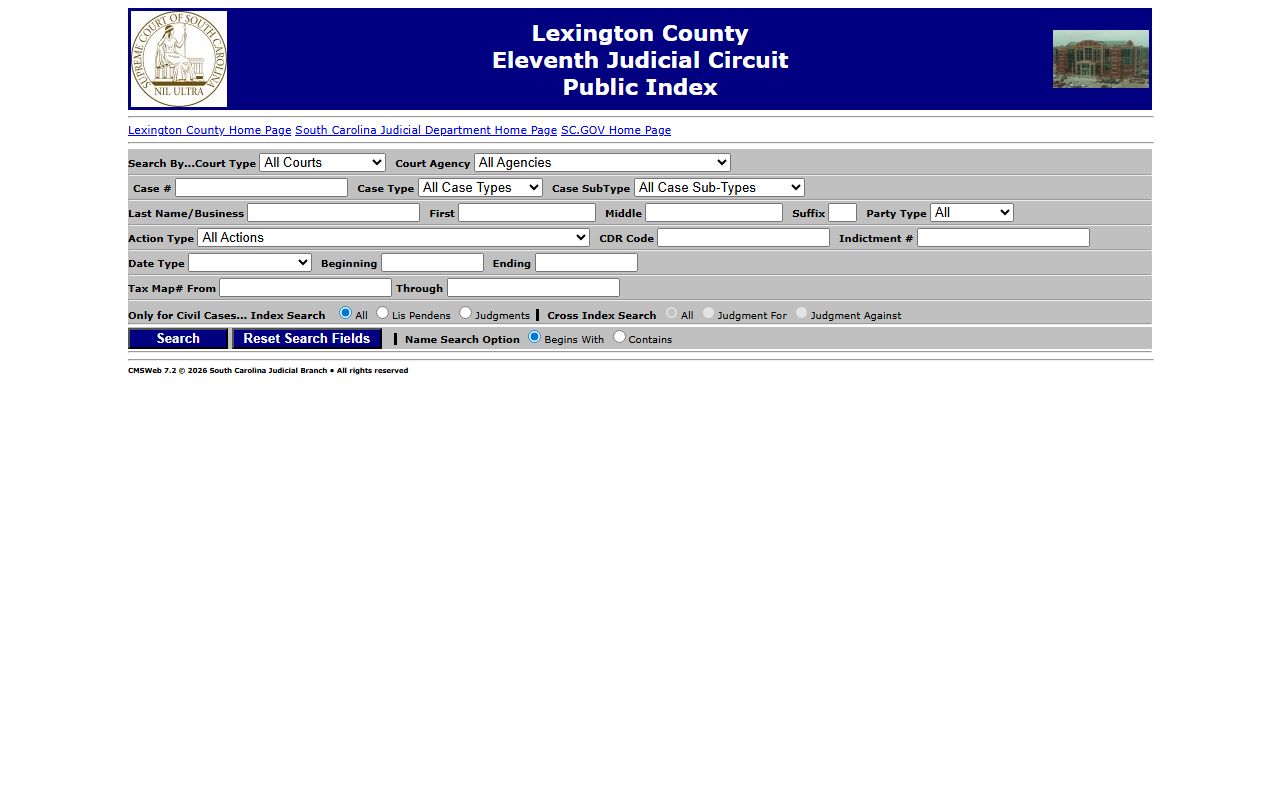
The Lexington County Public Index is the main county search page for court cases.
Here is a basic search path that works for most cases.
- Open the South Carolina Judicial Branch Case Records Search or go straight to the Lexington County Public Index.
- Pick Lexington County if you started from the statewide page.
- Choose the court that matches the case. Use Circuit Court for Common Pleas and General Sessions, and Magistrate Court for traffic, small claims, and minor crimes.
- Search by case number when you have it, or by party name when you do not.
- Open the case and review the parties, filing date, charges, and docket entries.
- For a certified copy or a record not shown online, contact the Clerk of Court at (803) 785-8212.
Family Court records do not appear in the Public Index. Those move through the state Family Court portal, covered below and on the Lexington County court records page.
The Lexington County Judicial System
South Carolina's main trial court is the Circuit Court, the court of general jurisdiction. Its civil side is the Court of Common Pleas and its criminal side is the Court of General Sessions. The Circuit Court also hears appeals from Probate, Magistrate, and Municipal courts. The state runs 16 judicial circuits, and Lexington County belongs to the Eleventh Judicial Circuit along with Edgefield, McCormick, and Saluda counties.
Below the Circuit Court sit the summary courts. Magistrate Court is the county's small claims and summary criminal court. Municipal courts handle city ordinance and city traffic cases. Probate Court and Family Court each run on their own track. The South Carolina Judicial Branch explains the role of the Circuit Court in more detail.
Case flow: Magistrate & Municipal Courts › Circuit Court › Court of Appeals › Supreme Court of South Carolina
| Court | Jurisdiction | Case Types |
|---|---|---|
| Circuit Court | General jurisdiction | Felonies, major civil suits, foreclosures, appeals from lower courts |
| Family Court | Domestic relations | Divorce, custody, child support, orders of protection |
| Probate Court | Estates and status | Wills, estates, guardianships, marriage licenses, commitments |
| Magistrate Court | Summary court | Traffic, small claims up to $7,500, minor crimes, evictions, bond |
| Municipal Court | City limits | City ordinance violations and city traffic cases |
The Eleventh Circuit Solicitor, Rick Hubbard, prosecutes criminal cases for the four-county circuit from the Judicial Center in Lexington. Circuit judges are elected by the General Assembly and serve six-year staggered terms.
Lexington County Courthouses
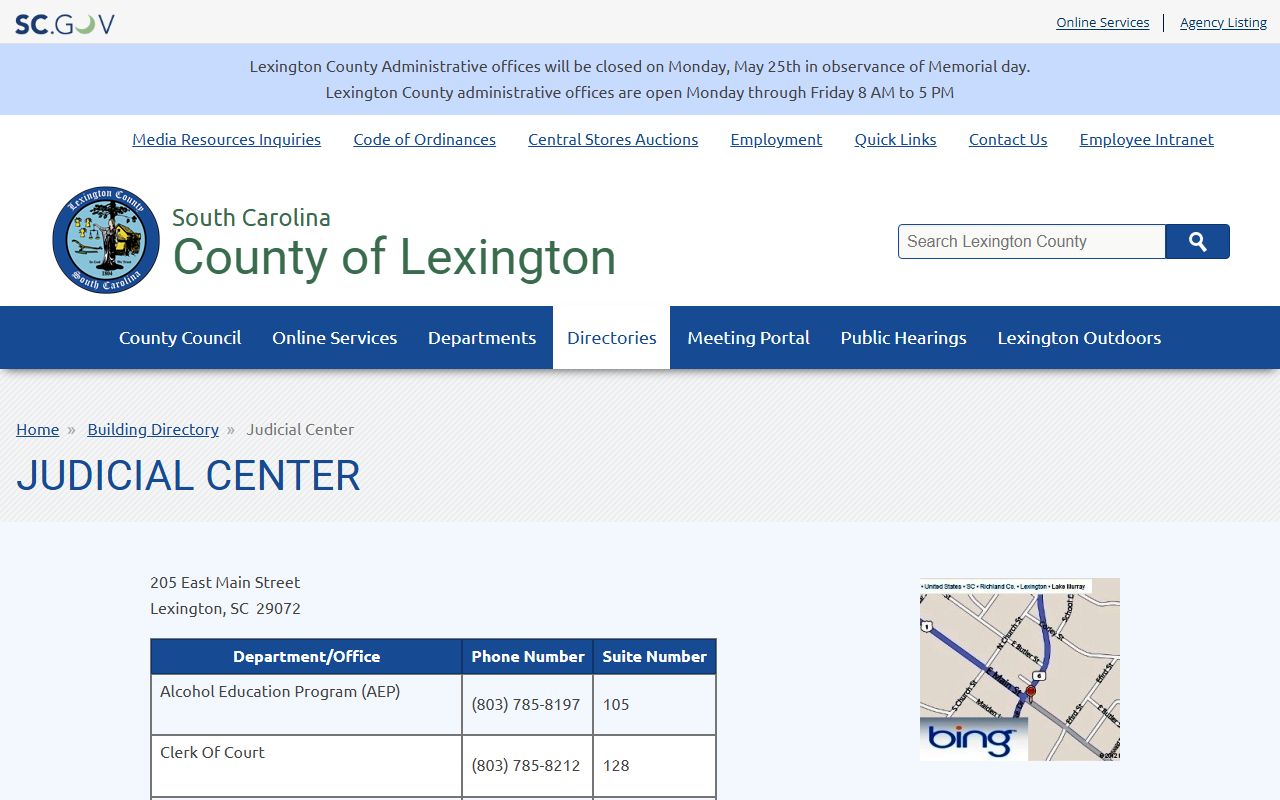
The main court building is the Marc H. Westbrook Lexington County Judicial Center at 205 East Main Street. It holds the Clerk of Court, Family Court, Probate Court, Master-in-Equity, the Solicitor's Office, and the county's diversion programs. Two other buildings carry a court role. Central Traffic Court and DUI Court sit at the old courthouse at 139 East Main Street. Bond Court runs at the Sheriff's complex at 521 Gibson Road.
The county building directory lists the offices, suite numbers, and phone lines for the Judicial Center.
Visitors often mix up the three addresses, so check your paperwork before you drive.
Marc H. Westbrook Judicial Center
205 East Main Street
Lexington, SC 29072
(803) 785-8212
Central Traffic Court & DUI Court
139 East Main Street, Suite A
Lexington, SC 29072
(803) 785-2142
Types of Court Records Available in Lexington County
The county courts produce many record types, and each one lands with a set office. Criminal and civil case files sit with the Clerk of Court. Family matters run through Family Court. Estates and marriage licenses are Probate Court records. Traffic tickets are mostly summary court records held by the magistrate or a city court.
Knowing which court holds a record saves a trip. Most case records are public, but some are sealed or restricted by law.
- Criminal records - General Sessions felony cases and Magistrate misdemeanor cases, searchable on the Public Index.
- Civil records - Common Pleas suits, judgments, liens, and Master-in-Equity foreclosure files.
- Family and divorce records - divorce, custody, and support cases held by Family Court.
- Probate records - wills, estates, guardianships, and marriage licenses.
- Traffic court records - citations, dispositions, and fines from Central Traffic Court or a city court.
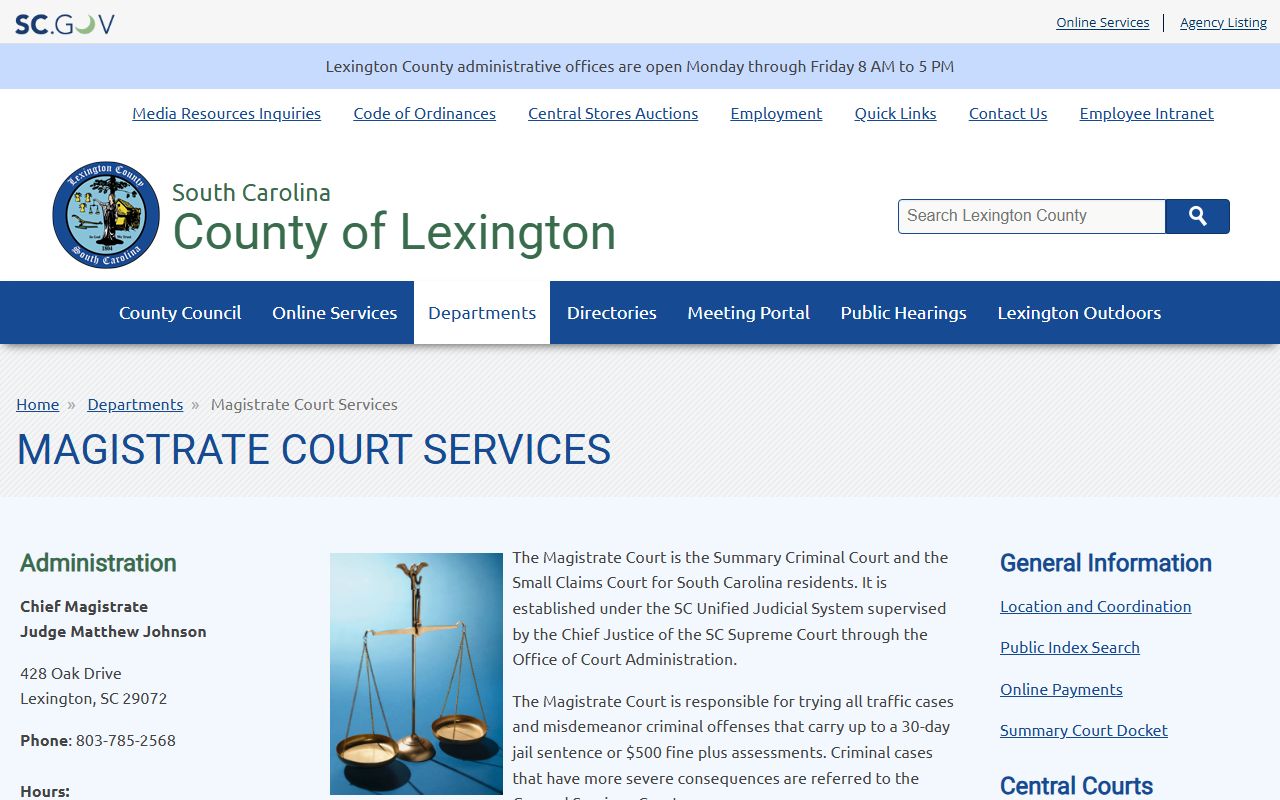
The county Magistrate Court Services page lays out the summary court's reach and links its forms.
What Lexington County Court Records Show
A court record holds the facts of a case from start to finish. The exact fields change with case type, but most records share a common spine. A criminal file adds charges, bond, and sentence. A civil file adds claims, judgments, and money owed. As of January 1, 2026, home address information no longer shows on the Public Index for new or existing cases.
| Field | What It Shows |
|---|---|
| Case Number | The court's unique ID, encoding year, court type, county, and sequence |
| Filing Date | The date the case was opened with the court |
| Parties | Plaintiff and defendant, or petitioner and respondent |
| Charges / Cause | The criminal charge and statute, or the civil claim |
| Disposition | The outcome, such as dismissed, guilty, or judgment entered |
| Sentence / Judgment | The penalty, money owed, or final order in the case |
Records also list the judge, attorney or law firm, docket entries, and hearing dates. Not every document can be downloaded; certified copies come from the Clerk.
Public Access Laws for Lexington County Court Records
South Carolina's Freedom of Information Act, in Title 30, Chapter 4 of the state code, sets the rule that public business stays open. It gives the public the right to inspect and copy records held by county offices and the Sheriff's Department, subject to fees and a short list of exemptions. Court records also answer to court rules and sealing orders. Jail custody records are open under FOIA for the prior three months, though medical, juvenile, and victim details can be withheld.
Key Statutes:
South Carolina Code § 30-4-15 - states the open-government purpose: public business is done openly at minimum cost or delay.
South Carolina Code § 30-4-30 - sets the right to inspect and copy records, response timing, and reasonable fees.
South Carolina Code § 30-2-10 - the Family Privacy Protection Act, which limits use of personal data from records.
A denied request can be challenged in court. South Carolina does not use a public access counselor, so the path runs through the judicial system.
Records That Are Restricted or Confidential
Not every record is open. Juvenile records are restricted by state law and court practice. Sexual assault victim reports cannot be released through routine channels. Sealed and expunged criminal records leave public view once a judge signs the order. Mental health commitments handled by Probate Court are protected, and adoption files are confidential.
To view a sealed record, a person usually must ask the court that holds it and show a legal reason. Most adult expungements run through the Eleventh Circuit Solicitor's expungement services at the Judicial Center. Summary courts must expunge cases that end in not guilty, dismissal, or nolle prosse, with no fee charged for that step under South Carolina Code § 17-22-950.
Specialty Courts in Lexington County
Lexington County runs a court-supervised diversion track for serious cases tied to addiction. The Lexington County Adult Drug Treatment Court is operated by the Eleventh Circuit Solicitor. It is a multi-agency alternative to prosecution for high-risk, high-need offenders, and most people spend 18 to 24 months in the program. Entry is the Solicitor's call under prosecutorial discretion, and the team includes prosecutors, defense lawyers, judges, probation agents, and treatment providers.
The Solicitor also offers Pre-Trial Intervention, the Alcohol Education Program, and the Traffic Education Program. Master-in-Equity is a civil specialty function, a division of Circuit Court that hears most foreclosure cases assigned by an Order of Reference. Judicial sales run on the first Monday of the month in Courtroom 3-A of the Judicial Center.
Lexington County Sheriff and Jail
The Lexington County Sheriff's Department, led by Sheriff Jay Koon, serves more than 295,000 residents and runs the Lexington County Detention Center at 521 Gibson Road. The 2024 average daily jail population was 641. Booking handled about 22 people a day, and the jail logged 8,091 bookings for the year. Bond Court meets twice a day on weekdays and once across the weekend.
The Sheriff's public inmate inquiry shows who is in custody now. For the full roster fields and how to use it, see Lexington County inmate records, and check warrant records for how the county handles active warrants. The Sheriff's Department publishes its accreditation and detention details online.
Marriage, Divorce, and Probate Records
Probate Court issues marriage licenses and keeps marriage records from 1911 to the present. Divorce records are different; they are Family Court files held by the Clerk of Court. Estates, guardianships, and conservatorships are all Probate Court matters. See marriage and divorce records and probate records for the full steps, fees, and search links.
- Testator
- A person who makes a will.
- Executor
- The person named to carry out the terms of a will, also called a personal representative.
- Conservator
- A person appointed to manage the money and property of someone who cannot do so alone.
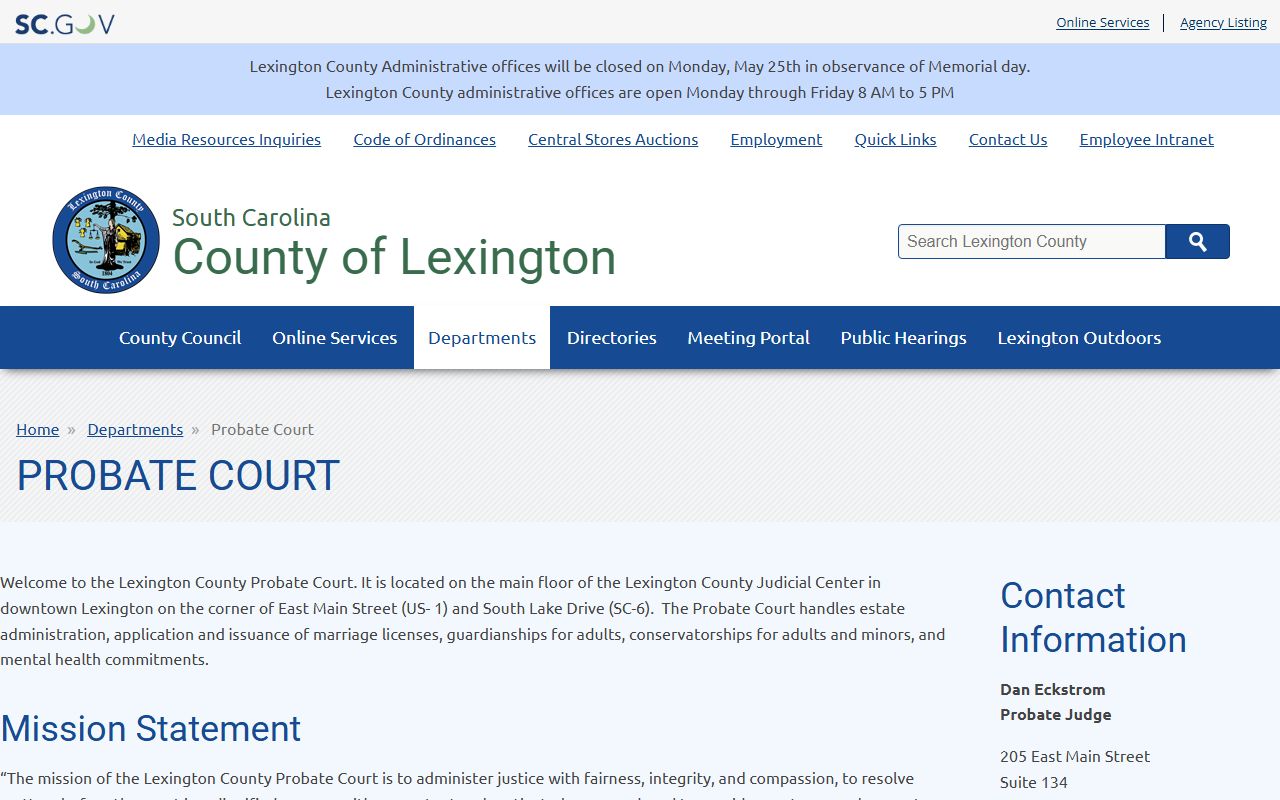
The county Probate Court page links its estate and marriage searches by date range.
Lexington County Court Records Fees
Copy and certification fees vary by office. Probate Court and the Clerk both charge for certified copies and extra pages. The numbers below come from the county's posted fee pages. Pay by check or money order; some offices do not take cash by mail.
| Item | Amount |
|---|---|
| Notary commission registration (Clerk) | $10.00 |
| Probate photocopy | $0.25 per page |
| Probate certified copy | $5.00 plus $0.25 per page |
| Exemplified / authenticated copy | $20.00 |
| Marriage license certified copy | $5.25 |
The Clerk of Court page and the probate records page list the full fee detail for each office.
How to Interpret Lexington County Court Records
Court files use shorthand that can confuse first-time readers. An open or pending case still has events left. A closed or disposed case has reached a final order. Dismissed or nolle prossed means the charge was dropped. A judgment is the final civil decision, and a bench warrant is issued after a missed court date.
One key point trips people up. An arrest is not a conviction. A charge only means the state accused someone; a conviction means a guilty plea or finding. The disposition line is where the real outcome shows. For the difference between an arrest record and a full case history, see the arrest records page.
Accuracy and Record Limitations
Online records lag behind the courtroom. A clerk has to enter a ruling before it shows on the Public Index, so a recent event may not appear right away. Names can also match more than one person, and old cases may carry data entry errors.
Note: Confirm any detail that matters with the office that holds the record before you rely on it for a legal, hiring, or housing decision.
History of Lexington County Courts
Court business in the area is old. The first courthouse and jail stood in Granby, in present-day Cayce. A courthouse and jail built in 1940 at 139 Main Street held up to 42 inmates, and that building still anchors Central Traffic Court and several magistrate functions today. The county's records role grew with the population, and the modern Judicial Center now centralizes the Clerk, Probate, Family, and Solicitor offices under one roof.
The state self-help portal is a good starting point for forms and plain-language guides.
Frequently Asked Questions
How do I search Lexington County court records online?
Use the South Carolina Judicial Branch Case Records Search and pick Lexington County, or go straight to the Lexington County Public Index. The statewide page needs cookies and JavaScript on, and some browsers need a pop-up exception to open case detail. Family Court cases use a separate state portal, and Probate Court runs its own estate and marriage searches.
Who keeps Lexington County court records?
The Lexington County Clerk of Court keeps Common Pleas civil, General Sessions criminal, and Family Court support records. Probate Court holds estate and marriage records. The Clerk's office is at 205 East Main Street, and the phone is (803) 785-8212.
Does the Clerk handle traffic tickets?
No. The Clerk's office does not handle speeding tickets. Check the court listed on the ticket. If it says Traffic Court at 139 East Main Street, call (803) 785-2142. If it says Town of Lexington, call (803) 951-4634.
More on the Lexington County Court Records FAQ page.